


Science, technology and society shape one another
01 CENTRE UPDATES
News
 Education15.07.2026
Our Master’s Programme in Science, Technology and Society holds its second Thesis Project Presentation DayOn Friday 10 July, students from the Master’s Programme in Science, Technology and Society at Universidad Alberto Hurtado gathered for the programme’s second Thesis Project Workshop. The event was held in the University’s central meeting room and was led by Francisco Salinas, director of the programme and a member of the Department of Sociology, together with Daniel Valenzuela, lecturer on the STS Research Workshop II.
During the session, ten students from the 2025 cohort shared their research in progress with their peers and members of the academic staff. The presentations were organised into two thematic blocks: “Infrastructures, Mediations and Sociotechnical Circulation” and “Territories, Ecologies and Sociotechnical Controversies”.
The session showcased a wide range of projects addressing language revitalisation, the circulation of technologies, applied science, community-based systems, socio-environmental conflicts, and the relationships between knowledge, territory and technology. Each block was followed by an open discussion, giving students and academics the opportunity to ask questions, share reflections and suggest directions for further developing the projects.
The session marks an important stage in the Master’s programme, giving students the opportunity to present their projects, discuss their ideas collectively and receive feedback to further develop their theses. It also reaffirms the commitment of Chile’s first Master’s programme in the field to fostering a vibrant space for debate on technoscience, the environment and society.
Further information about the programme — delivered in a synchronous blended format and accredited by Chile’s National Accreditation Commission (CNA) for five years, through to 2029 — is available here:
More about the Master’s Programme in Science, Technology and Society
Education15.07.2026
Our Master’s Programme in Science, Technology and Society holds its second Thesis Project Presentation DayOn Friday 10 July, students from the Master’s Programme in Science, Technology and Society at Universidad Alberto Hurtado gathered for the programme’s second Thesis Project Workshop. The event was held in the University’s central meeting room and was led by Francisco Salinas, director of the programme and a member of the Department of Sociology, together with Daniel Valenzuela, lecturer on the STS Research Workshop II.
During the session, ten students from the 2025 cohort shared their research in progress with their peers and members of the academic staff. The presentations were organised into two thematic blocks: “Infrastructures, Mediations and Sociotechnical Circulation” and “Territories, Ecologies and Sociotechnical Controversies”.
The session showcased a wide range of projects addressing language revitalisation, the circulation of technologies, applied science, community-based systems, socio-environmental conflicts, and the relationships between knowledge, territory and technology. Each block was followed by an open discussion, giving students and academics the opportunity to ask questions, share reflections and suggest directions for further developing the projects.
The session marks an important stage in the Master’s programme, giving students the opportunity to present their projects, discuss their ideas collectively and receive feedback to further develop their theses. It also reaffirms the commitment of Chile’s first Master’s programme in the field to fostering a vibrant space for debate on technoscience, the environment and society.
Further information about the programme — delivered in a synchronous blended format and accredited by Chile’s National Accreditation Commission (CNA) for five years, through to 2029 — is available here:
More about the Master’s Programme in Science, Technology and Society
List of projects presented
Block “Infrastructures, mediations and sociotechnical circulation”
- Reconstructing a language: an STS approach to the revitalisation of Kunza — Cristina Flores
- Chips, flea markets and the spread of video gaming. Piracy networks around the PlayStation 1 console in Chile’s transition years (1995–2005) — Aarón Cabello
- Formulating applied science: the performative role of the FONDEF IDeA application form in the construction of applied science in the natural and exact sciences in Chile — Patricia Piña
- Networks that do not transfer: Networks that do not transfer: a sociotechnical reading of technology transfer in Chile — Rodrigo Tapia
- The punched tape of Talasa. Design, performativities and possibilities for (re)assembling a supercomputing ecosystem — Juan Aguilera Manzor
Block “Territories, ecologies and sociotechnical controversies”
- Hyphae and primordia: tracing a more-than-human network in the encounters between scientists and fungi in spaces of material production — David Gutiérrez
- In search of clues to the durability of sociotechnical systems in community settings: the case of a social technology for endemic quinoa production in Petorca — Barbra Garland
- The production of non-knowledge (ignorance): on the over-exploitation of the Pampa del Tamarugal aquifer in northern Chile — Eduardo Vega Catalán
- “Private property is (not) a Sanctuary”: ontological frictions in the socio-environmental dispute over the Tinquilco Basin Nature Sanctuary — Bastián Torres
- The Malleco Line: technology and the closure of territorial autonomy — Rafael Urtubia
...
News

List of projects presented
Block “Infrastructures, mediations and sociotechnical circulation”
- Reconstructing a language: an STS approach to the revitalisation of Kunza — Cristina Flores
- Chips, flea markets and the spread of video gaming. Piracy networks around the PlayStation 1 console in Chile’s transition years (1995–2005) — Aarón Cabello
- Formulating applied science: the performative role of the FONDEF IDeA application form in the construction of applied science in the natural and exact sciences in Chile — Patricia Piña
- Networks that do not transfer: Networks that do not transfer: a sociotechnical reading of technology transfer in Chile — Rodrigo Tapia
- The punched tape of Talasa. Design, performativities and possibilities for (re)assembling a supercomputing ecosystem — Juan Aguilera Manzor
Block “Territories, ecologies and sociotechnical controversies”
- Hyphae and primordia: tracing a more-than-human network in the encounters between scientists and fungi in spaces of material production — David Gutiérrez
- In search of clues to the durability of sociotechnical systems in community settings: the case of a social technology for endemic quinoa production in Petorca — Barbra Garland
- The production of non-knowledge (ignorance): on the over-exploitation of the Pampa del Tamarugal aquifer in northern Chile — Eduardo Vega Catalán
- “Private property is (not) a Sanctuary”: ontological frictions in the socio-environmental dispute over the Tinquilco Basin Nature Sanctuary — Bastián Torres
- The Malleco Line: technology and the closure of territorial autonomy — Rafael Urtubia


02 WHO DOES THE RESEARCH
Team
CECTS researchers and support team
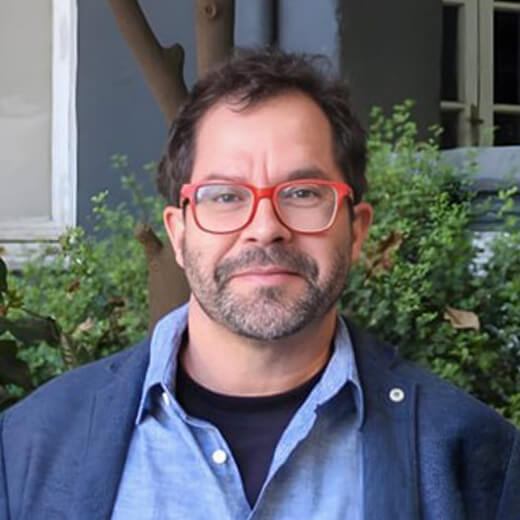
Cristóbal Bonelli
DIRECTOR AND RESEARCHERDepartment of SociologySocial anthropologist and psychologist, director of CECTS, director of Research at the Faculty of Social Sciences and associate professor of Sociology at Universidad Alberto Hurtado. His research brings together Science and Technology studies (STS), environmental anthropology and socio-ecological transitions. He has led projects linking international networks and funding with research in Chile on mining, energy and infrastructure, including the ERC Worlds of Lithium and the Marie Skłodowska-Curie project Invisible Waters..Read more
Claudio Ramos Zincke
RESEARCHERDepartment of SociologySociologist, with undergraduate and master’s studies at Pontificia Universidad Católica de Chile and master’s and doctoral studies at the University of Texas at Austin. Over the past fifteen years he has researched different assemblages between scientific and technical constructs and society, addressing school assessment systems, poverty measurement, university admissions, domestic violence and sociological narratives. His current research focuses on artificial intelligence.Read more
Amaranta Alfaro Muirhead
RESEARCHERDepartment of JournalismFaculty member at Universidad Alberto Hurtado and PhD candidate at the University of Hamburg. Erasmus Mundus MA in Media, Communication and Cultural Studies. She is a member of Chile Kids Online, ALFAMED and the AUSJAL network. Her research covers children’s and adolescents’ relationships with digital technologies, digital participation and citizenship, online gender-based violence, and media framing and hate speech around migration. She is an associate researcher at CIPP-UAH and CECTS-UAH.Read more
Francisco Salinas
RESEARCHERDepartment of SociologyDirector of the Master’s Programme in Science, Technology and Society at Universidad Alberto Hurtado. PhD in Sociology of Knowledge from University College London. Research areas: social theory, the sociology of experts, and science, technology and environment studies. He leads FONDECYT project 11260033, “Towards a hydro-sociology of experts” (2026–2029), focused on scientific and technical knowledge, objects and practices around water in Chile.
Read more
Francisca Márquez
RESEARCHERDepartment of AnthropologyAnthropologist (Universidad de Chile) and PhD in Sociology from the Université Catholique de Louvain. Full professor in the Department of Anthropology at Universidad Alberto Hurtado. She has carried out research on urban identities and imaginaries, heritage, ruins and rubble in Latin America. She is currently researching the relationships between urban subsoils and infrastructures. Her recent publications include Objetos de Memoria (2025) and Ruina y Escombro en Latinoamérica (2023).Read more
Sebastián Ansaldo
RESEARCHERDepartment of JournalismDirector of the Department of Journalism at Universidad Alberto Hurtado. Journalist and MA in Communication from Universidad Diego Portales, MPhil in Sociology (Media and Culture) and PhD in Education from the University of Cambridge. His research focuses on communication, education, digital platforms, mediatisation and cultural studies, with particular interest in the mediations that shape contemporary sociotechnical processes.Read more
Mitzi Duboy Luengo
RESEARCHERDepartment of Social WorkSocial worker, MA in Social Policy and PhD in Social Work. Her research spans three main areas: social policy implementation and street-level bureaucracies; professional resistance, feminisms and the sustainability of life; and knowledge production, critical epistemologies and Science, Technology and Society studies (STS), with particular interest in the relationships between professional practices, policies and forms of knowledge.Read more
Renato Moretti Tapia
RESEARCHERFaculty of PsychologyPhD in Sociology and psychologist, assistant professor in the Department of Educational Psychology at Universidad Alberto Hurtado and researcher at CECTS. His work connects the history of education and psychology in Chile with the social studies of science and technology, examining teacher evaluation policies and educational merit from a historical and critical perspective.Read more
Antonia Condeza-Marmentini
RESEARCHERFaculty of EducationGeographer and PhD in Education, faculty member of the Faculty of Education at Universidad Alberto Hurtado. Her research areas are the formation of environmental citizenships, teaching competencies in contexts of socio-ecological crisis, and situated pedagogies. Her research purpose is the construction of desired imaginaries and social projects for life in post-extractivist contexts.Read more
Cristian Olivares Rodríguez
RESEARCHERFaculty of EngineeringComputer Engineer (UCSC), MSc in Computer Vision and Artificial Intelligence from the Universitat Autònoma de Barcelona and PhD in Engineering from the University of Deusto. Faculty member of the Faculty of Engineering at Universidad Alberto Hurtado. His research addresses citizen participation in the construction of technologies and technological mediation in building capacities for disaster risk management.Read more
Cecilia Bettoni
RESEARCHERDepartment of ArtArt historian and faculty member of the Department of Art at Universidad Alberto Hurtado. PhD in Philosophy from Universidad de Chile. Her research addresses the modernisation of Chilean and Latin American art, with particular interest in artistic institutions and systems. She is the author of La tristeza de nuestros museos. Derivas de la modernidad en América Latina (Metales Pesados, 2024), as well as numerous essays, articles and translations.Read more
Nicolás Trujillo
Visiting ProfessorFaculty of Philosophy and HumanitiesPhD in Philosophy, specialising in the epistemology of science and in science, technology and innovation policy, from Leiden University and Universidad Diego Portales. Visiting professor at the Faculty of Philosophy and Humanities of Universidad Alberto Hurtado. Researcher, consultant and adviser specialising in public policy, national systems and international cooperation in science, technology and innovation (STI).Read more
Tomás Undurraga
RESEARCHERDepartment of SociologySociologist and PhD in Sociology from the University of Cambridge, with postdoctoral research in Science and Technology Studies at University College London. Full professor in the Department of Sociology at Universidad Alberto Hurtado. His research brings together economic sociology, science, technology and environment, and cultural sociology. He currently studies the valuation of forests, green hydrogen futures, the social crisis of water and controversies over the Chilean economic model.Read more
Felipe Trujillo Bilbao
RESEARCHERDepartment of AnthropologySocial anthropologist and MA in Contemporary Chilean History from Universidad Alberto Hurtado, and PhD in History from Pontificia Universidad Católica de Chile. Faculty member of the UAH Department of Anthropology and adjunct researcher at the ICLAC Millennium Nucleus. His research addresses the relationships between science, technology and society, with an emphasis on the environment and knowledge infrastructures, water scarcity and the sociotechnical transformations of Chilean agronomy.Read moreInternational Advisory Board

Dipesh Chakrabarty
University of ChicagoLawrence A. Kimpton Distinguished Service Professor at the University of Chicago and a founding figure in subaltern and postcolonial studies. His recent work has reshaped debates on climate change, the Anthropocene and the planetary condition, exploring how the ecological crisis challenges established categories of historical thought and reconfigures relations between the humanities, social sciences and natural sciences.Read more
Marisol de la Cadena
University of California, DavisProfessor of Anthropology and Science and Technology Studies (STS) at the University of California, Davis. Her work has opened up new ways of thinking about indigeneity, cosmopolitics, ecology of practices and more-than-human worlds, exploring partial connections across divergent worlds. She is the author of Earth Beings and is currently working on a multispecies ethnography in Colombia.Read moreStudents and visiting members

Kenneth Fowler Berenguer
BSc in Chemistry and PhD student in Sociology at UAH, associated with the CITEC Millennium Nucleus. His doctoral research addresses the intersection between datafication and social movements. At CECTS he carries out administrative and communications support, including the development and updating of the Centre’s communications and website. Read more
Clara Salina
Visual artist, MA in Government, Public Policy and Territory, and PhD student in Sociology at UAH. Her thesis addresses art as a tool for developing environmental awareness. She is linked to CECTS through the EcoDilemas project and through initiatives connecting artistic practices and the environment.Read more
Pablo Castillo
Sociologist and student on the UAH Master’s Programme in Science, Technology and Society. His thesis explores processes of subjectivation, embodiment and screen–nature relations among heavy TikTok users. He is linked to CECTS through a project funded by Universidad Alberto Hurtado’s DIDCA Fund.Read more
Ámbar Ángel Toledo
BA in Social Anthropology and student on the UAH Master’s Programme in Science, Technology and Society. Her thesis analyses how HIV Pre-Exposure Prophylaxis (PrEP) reorganises time and care practices in Santiago. At CECTS she is involved in organising the First Meeting of STS Thesis Students.Read more
Antonia Hargreaves Bueno
Psychologist and MA in Psychology (Social Psychology) from Universidad Diego Portales. She is currently a PhD student in Sociology at Universidad Alberto Hurtado. Her research addresses Game Studies , video games and the body. At CECTS she takes part in the EcoDilemas project, which is developing a serious game.Read more
Evelyn Norambuena
Sociologist and MA in Social Psychology from Universidad Alberto Hurtado, where she is currently a PhD student in Sociology. Her doctoral research addresses the sociology of health, gender and public policy. She is linked to CECTS through communications support work, carried out as part of the service commitment of her 2026 UAH doctoral scholarship.Read more
José Ignacio Pinto Galaz
Anthropologist, MA in Sociocultural Anthropology and PhD student in Sociology at UAH. His research addresses scientific activism and cosmopolitical networks in ecological winegrowing. He is linked to CECTS as a research assistant on the FONDECYT project “Towards a hydro-sociology of experts”, led by Francisco Salinas.
Read more
Camila Torralbo
Sociologist, BA in Arts and MA in STS. Her doctoral research in sociology focuses on understanding the social, technological and regulatory challenges arising in the development of export-oriented green hydrogen projects. She is linked to CECTS through her coordination of the Science, Technology and Environment Reading Group.Read more
02 WHO DOES THE RESEARCH
Team
CECTS researchers and support team
Cristóbal Bonelli
Claudio Ramos Zincke
Amaranta Alfaro Muirhead
Francisco Salinas
Director of the Master’s Programme in Science, Technology and Society at Universidad Alberto Hurtado. PhD in Sociology of Knowledge from University College London. Research areas: social theory, the sociology of experts, and science, technology and environment studies. He leads FONDECYT project 11260033, “Towards a hydro-sociology of experts” (2026–2029), focused on scientific and technical knowledge, objects and practices around water in Chile.
Francisca Márquez
Sebastián Ansaldo
Mitzi Duboy Luengo
Renato Moretti Tapia
Antonia Condeza-Marmentini
Cristian Olivares Rodríguez
Cecilia Bettoni
Nicolás Trujillo
Tomás Undurraga
Felipe Trujillo Bilbao
International Advisory Board
Dipesh Chakrabarty
Marisol de la Cadena
Students and visiting members
Kenneth Fowler Berenguer
Clara Salina
Pablo Castillo
Ámbar Ángel Toledo
Antonia Hargreaves Bueno
Evelyn Norambuena
José Ignacio Pinto Galaz
Anthropologist, MA in Sociocultural Anthropology and PhD student in Sociology at UAH. His research addresses scientific activism and cosmopolitical networks in ecological winegrowing. He is linked to CECTS as a research assistant on the FONDECYT project “Towards a hydro-sociology of experts”, led by Francisco Salinas.
Camila Torralbo
03 WHAT WE STUDY
Research
Our research is organised into three fluid areas where diverse problems, questions and practices converge. Within them we experiment with different ways of knowing and intervening, following connections and trying out new ways of researching and collaborating.
03 WHAT WE STUDY
Research
Our research is organised into three fluid areas where diverse problems, questions and practices converge. Within them we experiment with different ways of knowing and intervening, following connections and trying out new ways of researching and collaborating.
Experimentation, Association and Habitability
We explore and experiment with diferent forms of association, collaboration and inter- and transdisciplinary knowledge production. Through collaboration between universities, public institutions, civil society organisations and communities, we drive experimental processes aimed at strengthening the conditions of habitability of our territories.Projects in this research area
Experimentation, Association and Habitability
Socio-ecologicaltransformations
We investigate how the climate crisis, energy transitions and other transformations reconfigure relations between territories, infrastructures, communities and forms of life, exploring the frictions, tensions and equivocations that emerge in attempts at coexistence between humans and non-humans.Projects in this research area
Socio-ecologicaltransformations
Technologies, knowledges and contemporary life
We study how technoscientific practices participate in shaping contemporary life, attending to the diversity of knowledges and ways of inhabiting the world in fields such as health, digital worlds, artificial intelligence, work and education.
Projects in this research area
Technologies, knowledges and contemporary life
We study how technoscientific practices participate in shaping contemporary life, attending to the diversity of knowledges and ways of inhabiting the world in fields such as health, digital worlds, artificial intelligence, work and education.
04 ACADEMIC OUTPUT
Publications
MOST RECENT
2025Cultural sociology in Chile: the explanatory power of subjectivity
Cultural SociologyUndurraga, T., Frei, R., & Güell, P.
2025Anticipating green hydrogen futures: exploring the socio-material production of a new clean fuel
Journal of Cultural EconomyAriztía, T., & Undurraga, T.
2025¿La doble crisis de la sociología en Chile? Debates sobre su quehacer y su relevancia
Pléyade, 35, 25–40Undurraga, T., & Ariztía, T.
04 ACADEMIC OUTPUT
Publications
MOST RECENT
Cultural sociology in Chile: the explanatory power of subjectivity
Anticipating green hydrogen futures: exploring the socio-material production of a new clean fuel
¿La doble crisis de la sociología en Chile? Debates sobre su quehacer y su relevancia
05 AUDIOVISUAL CHANNEL
Multimedia
An audiovisual record of our seminars, colloquia and observation sessions.Coming soon ...
Multimedia
Coming soon ...